
Ashoka Eternal slot
Ashoka Eternal is an ELK Studios slot that brings back the Tiger Prince and his tiger from Ashoka, this time as a cluster pays game. It starts on a grid of 5 columns and 7 rows, where clusters of five or more matching symbols pay and drop away. Clearing the blockers around the symbols widens the grid to 7x7 and then 7x9, and a multiplier wheel can switch on a global multiplier.
Editorial note: this guide explains how Ashoka Eternal works. Rules, features and payout figures are set by the studio and can differ between operators and game versions, so check the game’s information panel before you play. Slots are games of chance, and nothing here predicts results. Availability at Fortune Games can change.
Play Ashoka Eternal and similar games · 18+


New to Fortune Games? Join today and see our welcome offer for new players.
18+. New players only. Welcome offer and T&Cs.
Ashoka Eternal: key facts
| Studio | ELK Studios |
|---|---|
| Grid and pays | 5 columns by 7 rows to start; clusters of 5 or more matching symbols, joined across or up and down |
| Grid growth | Clearing all the blockers expands the grid to 7x7, then to 7x9 |
| Maximum win | 25,000x stake |
| Symbols | Patterned stone blocks, gems and a tiger; symbols can land as 1x1, 2x2 or 3x3 blocks |
| Wilds | Substitute for any paying symbol and can land big |
| Charged Wild | Stays for up to 3 wins; 1x1, 2x2 or 3x3 |
| Multiplier wheel | The global multiplier is active when the wheel stops in the top position |
| Free drops bonus | 3 active bonus symbols anywhere on the main grid; each further active bonus symbol adds 2 free drops |
| Super Bonus | One of the triggering bonus symbols is a super bonus symbol; double the chance of the global multiplier |
| Autoplay and turbo | Not available at sites licensed in Great Britain; UK rules require at least 2.5 seconds between the start of one game cycle and the next |
| Stakes | UK rules cap online slot stakes at £5 a spin, or £2 if you are 18 to 24 |
| RTP | Shown in the game’s information panel |
| Series | Ashoka (a follow-up to the original) |
All values (Bet Levels, Maximum Wins etc.) mentioned in relation to this slot game are subject to change at any time.
How Ashoka Eternal plays
There are no paylines. Ashoka Eternal is a cluster pays slot, so a win needs at least five matching symbols touching each other across or up and down. The low-paying symbols are patterned stone blocks and the high-paying ones are gems and a tiger. Any of them can drop in as a single symbol or as a big 2x2 or 3x3 block, and the wilds can arrive in big sizes too.
Each spin is a drop rather than a spin of reels. When a cluster pays, its symbols are cleared, along with any blockers touching the win, and new symbols fall into the gaps. Any fresh cluster pays in turn, and the cascade runs on until no new win appears, so one drop can pay several times.
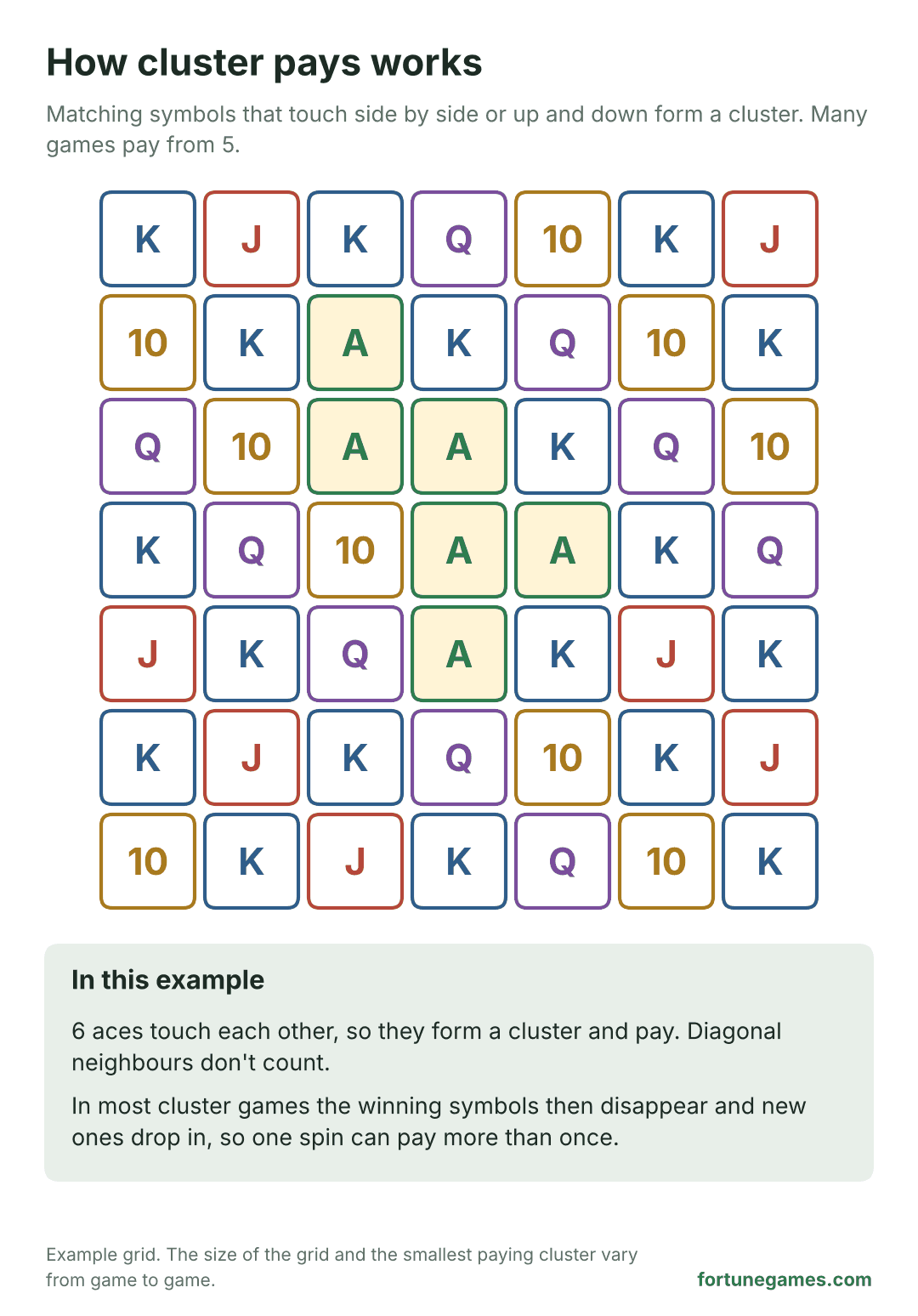
Ashoka Eternal: 5 columns by 7 rows to start; clusters of 5 or more matching symbols, joined across or up and down. Matching symbols that touch side by side pay as a cluster.
The growing grid and the multiplier wheel
Clearing blockers matters because it opens up space. Remove every blocker from the starting grid and it widens to 7x7. Clear that grid’s blockers too and it grows again, to 7x9, its largest size. In numbers, the starting grid has 35 positions, the 7x7 grid 49 and the 7x9 grid 63. The multiplier wheel works alongside the grid: whenever it stops with the activation symbol in the top position, the global multiplier is active.
Charged Wilds and big wilds
Wilds stand in for any paying symbol, and they can drop in at 1x1, 2x2 or 3x3, so a single big wild can link symbols across several columns. The Charged Wild is the one that lingers. Instead of clearing after one win like other symbols, it stays on the grid and can take part in up to three wins, after which it is removed. A 3x3 Charged Wild covers nine positions, and it can count towards three separate wins before it goes.
The free drops bonus and its multiplier
Free drops are the game’s free spins, played out one drop at a time. Three active bonus symbols anywhere on the main grid start the round. Every further active bonus symbol that lands during the round adds two more free drops, so the bonus can keep extending itself. The global multiplier also behaves differently here: once it is running, it carries over from one free drop to the next.
Ashoka Eternal at Fortune Games
Both Ashoka games are among the slots in the Fortune Games lobby (18+). The tiles above show the original Ashoka next to this one, with four more games alongside them. Whatever size the grid reaches, the stake for each drop stays within the UK caps in the key facts table. Fortune Games has an app on the App Store and Google Play.
Frequently asked questions
How is Ashoka Eternal different from Ashoka?
The original Ashoka is a six-reel slot that pays scatter-style, wherever matching symbols land. Ashoka Eternal swaps that for cluster pays on a 5x7 grid that grows as blockers clear. The Tiger Prince returns, both games have a regular and a super version of their bonus, and ELK quotes the same top win potential for each.
How do you get the Super Bonus in Ashoka Eternal?
It needs the same three active bonus symbols as the regular free drops, with one difference: one of the three must be a super bonus symbol. In the round that follows, the chance of the global multiplier switching on is doubled.
What happens to matching symbols that are not part of a win?
They go too. When a cluster pays, every other symbol of the same type on the grid is cleared along with it, even if it was not touching the cluster. That clears more of the grid at once before the next symbols fall in.
Related guides
Checked on 1 November 2026 against ELK Studios’ Ashoka Eternal and Ashoka game pages, the Bigwinboard and VegasSlotsOnline game records, and the Gambling Commission’s stake-limit guidance and remote technical standards. How we research and check our guides: our editorial policy.